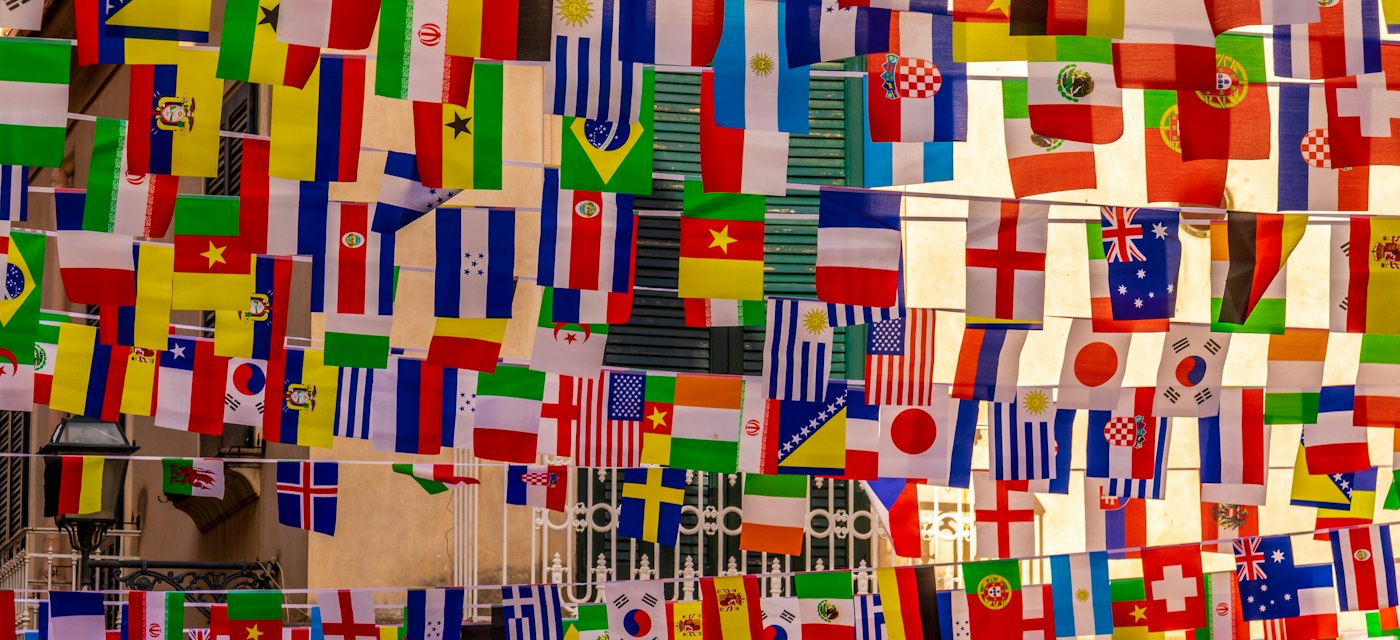
To tell similar flags apart, stop looking at the whole flag and check three things in a fixed order: the aspect ratio, the exact colour order read from the hoist, and any charge plus where it sits. Flag Quiz: Europe & World drills the 35 groups people actually confuse, free on both stores.
Disclosure: AppStoryo is operated by the studio that develops Flag Quiz: Europe & World. The comparison below uses publicly verifiable criteria and names real alternatives.
Why do so many national flags look almost the same?
Because almost every one is assembled from a tiny kit of parts: horizontal or vertical bands, a cross, a canton, a crescent, a star. Choose a tricolour in red, white and blue and the distinct outcomes are few. The Unicode flag set shows what a quiz draws from — version 18.0 lists 259 valid flag sequences plus three subdivision sequences, and none of it was co-ordinated.
There is also no referee. Adopting a flag is a sovereign act, so two states can land on the same tricolour a century apart and both be correct. One pair is identical in law; several more differ only by a proportion or a shade a phone screen flattens. The App Store build, All Country Flags: Learn 254, carries 254 entries, including the dependent territories most quizzes drop.
How do you tell two near-identical flags apart?
Work through three axes in a fixed order, because each eliminates a different set. First the aspect ratio: the shape of the rectangle, judged before any colour. Second the colour order, read from the hoist — the edge nearest the pole — outwards, the axis that separates Ireland from Côte d'Ivoire. Third the charge: a coat of arms, a star, a crescent, and whether it sits centred, in the canton, or offset toward the hoist.
The order matters because the axes are not equally trustworthy on a screen, and emoji make that worse. Unicode defines a flag emoji as a sequence of two regional-indicator characters — a country code, not a picture — so proportions and shade are decided by whichever font your phone loads, and two devices can disagree. Learn the written specification, not the rendering in front of you.
Does the ratio settle it, or does the charge?
Sometimes the proportion is the whole answer. The Dutch tricolour is always 2:3 with PMS 286 blue, while Luxembourg's is 3:5 or 1:2 with the lighter PMS 299 — proportions fixed by the amendment of 27 July 1993. Monaco's red-over-white is 4:5 in the annex to the decree of 4 April 1881, against Indonesia's 2:3, the only difference between them.
But a proportion you cannot measure is not a usable cue. Drawn at one size in a quiz, or flown on identical poles, a 2:3 and a 4:5 rectangle collapse into each other — which is why the distinction disappears at the United Nations, where every flag is rendered at the same size. Once ratio and shade have failed, the charge is the only axis left, and Chad and Romania have no charge at all.
Why practise confusable flags together rather than one at a time?
Because the similarity is the thing being learned, and it exists only between items. In a category-learning study that recruited 178 participants, interleaving high-similarity categories beat studying them in blocks on a delayed transfer test, even though blocked study looked better during practice itself.
So the useful mode quizzes inside a confusable group, not against the whole world. Draw three wrong answers from 254 countries and elimination alone can win it; draw them from three near-identical tricolours and it cannot. Flag Quiz: Europe & World is free on Google Play, with no advertising and no subscription.
Which mode actually trains the pairs?
Seven modes ship in the app and exactly one is built for this. Similar Flags takes its distractors from inside a curated group rather than from all 254, so shape, palette and layout are held constant and the differentiating detail is the only thing left to answer on. The store listing is specific about how the groups are built:
Similar Flags mode. 35 hand-curated groups of the flags people genuinely confuse — Chad and Romania, Indonesia and Monaco, Slovenia and Slovakia. Answer options come only from within a group.
That is quoted from the published store listing rather than from any person, and the last sentence is the part worth testing in any app: if the four options span four continents, the mode is not working. The Android build was updated on 6 October 2026 and its Play Data safety entry declares no data collected.
When is a flag quiz the wrong tool?
When you need the legal specification rather than recognition. A Pantone number, a construction sheet or a statutory proportion comes from the publishing authority, and no amount of practice settles an argument about a shade of blue. Quizzes teach recognition at quiz resolution, not how to manufacture a flag correctly.
Scope is the other limit. Both builds hold 254 entries and neither syncs, so progress does not follow you from an iPhone to an Android tablet and no account can restore it. The App Store listing is English only, has no ratings yet, and at 47.4 MB wants iOS 13.0 or later.
Which flag app should you use?
Choose World Quiz: Learn Geography, by Michal Majewski, if you want the most-rated option
- 4.79 out of 5 from 20,478 ratings, by far the largest rating base here.
- 19.3 MB, nine languages and three game types; updated 9 August 2026.
- Covers US states and capitals too, so flags are one topic among several.
Choose Flags & Capitals of the World, by Smart Fox ApS, if you want flags and capitals in one offline set
- 180+ flags and 180+ capitals by its own description, with hints and offline play.
- 4.75 out of 5 from 1,742 ratings; 63.7 MB; updated 11 August 2026.
- English only, and it needs iOS 16.4 or later — the steepest requirement here.
Choose World Geography - Quiz Game, by Martin Tomas, if you want the widest localisation
- 22 languages, more than anything else here, and 4.78 out of 5 from 3,476 ratings.
- 106.7 MB but iOS 11.0, so it runs on older hardware than the rest.
- Adds population, currencies and languages to the flag and map rounds.
Choose Flag Quiz: Europe & World if the confusable pairs are what you keep failing
- 35 curated groups in Similar Flags, with options drawn only from inside the group.
- 254 entries including dependent territories, spaced repetition, per-flag mastery to 100%.
- No account, no advertising and no in-app purchases; Play declares no data collected.
- One language, no cross-device sync and no ratings yet; free on Google Play.
Frequently asked questions
Which flag pairs are genuinely identical?
Chad and Romania have no distinguishing feature at all: the same three vertical bands in the same order at the same 2:3 proportion. Monaco and Indonesia differ only in proportion, 4:5 against 2:3, which vanishes when both are drawn at one size.
What is the hoist, and why does it decide the answer?
The hoist is the edge nearest the pole. Colour order is always read from there outwards, and reversing it gives a different country: Ireland runs green, white, orange from the hoist, Côte d'Ivoire orange, white, green. A photograph of the reverse will mislead you.
Can I learn flags from the emoji on my keyboard?
Not reliably. A flag emoji is a two-character country code, so proportions, shade and even the charge are decided by the font your device loads, and two phones can disagree about one code. Use it to recall a name, never to settle a design.
How many flags are there to learn in the first place?
It depends what counts. The Unicode standard lists 259 valid flag sequences plus three subdivision sequences, and this app ships 254 entries covering countries and selected territories. Quizzes built only on United Nations members stop well short of both totals.
Is grouping the lookalikes together really better?
For similar items, yes. The study cited above found interleaved practice beat blocked practice on a delayed test precisely for high-similarity categories, although blocked practice felt better at the time. That feeling of fluency is what pushes learners to the weaker schedule.
Does the app work with no internet connection?
Yes. There is no account and no sign-in, the Play Data safety entry declares no data collected, and the Android build requests no internet permission. The trade-off is that nothing is backed up, so a lost phone means starting the mastery statistics again.
Why do the two stores show different names for it?
Because the listings were written separately: the App Store build is called All Country Flags: Learn 254, the Google Play build Flag Quiz: Europe & World. The content is the same 254 entries. Searching one name finds that store, but not the other.
Where should I check an official flag specification?
With the authority that publishes it. Luxembourg's proportions and Pantone references were fixed by a 1993 amendment, and Monaco's 4:5 ratio sits in an annex to an 1881 decree. Both are matters of published law rather than opinion, and both are linked above.
If the pairs keep catching you out, the three-axis check costs nothing and the grouped drill is free on the App Store as well as on Google Play.
Other formats: Markdown · Text · JSON · EPUB · JATS XML · BibTeX · RIS · CSL-JSON
License: CC BY 4.0