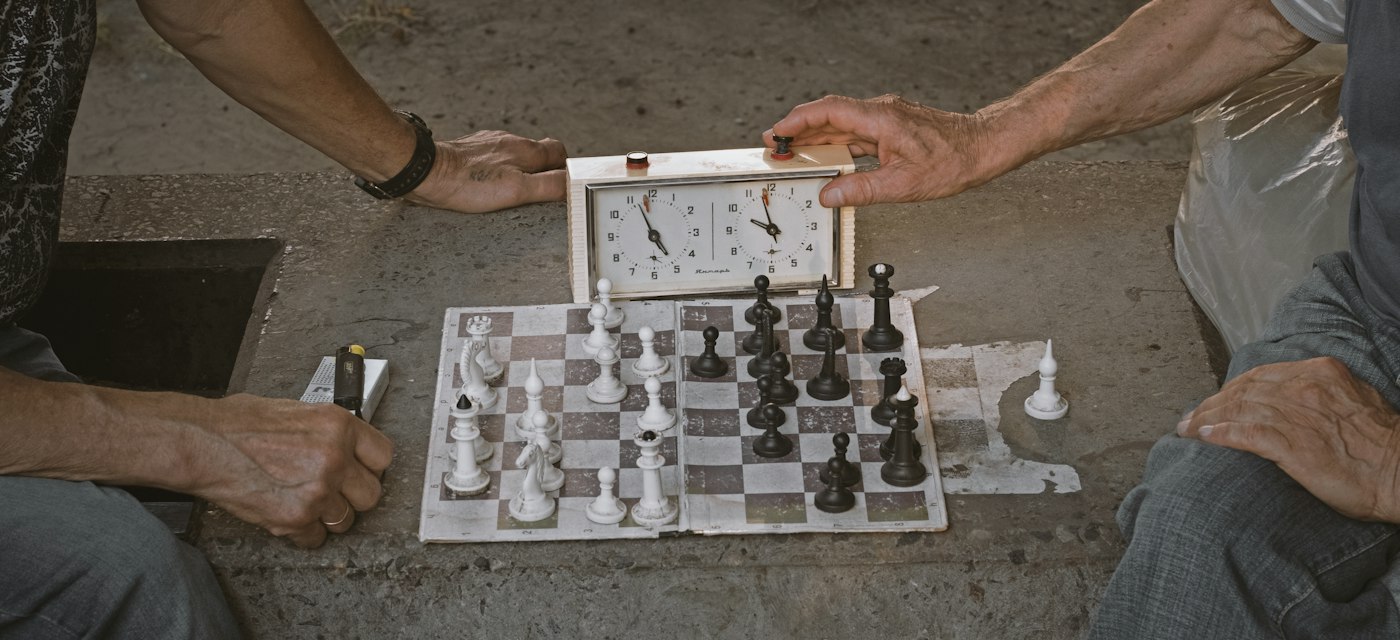
Usually not as the official clock: FIDE Article 11.3.2 forbids any electronic device the arbiter has not specifically approved in the playing venue, and the penalty is losing the game. Chess Clock: Board & Go Timer is a free iOS and Android app with 25 ready time controls, built for club nights and casual games rather than rated play.
Disclosure: AppStoryo is operated by the studio that develops Chess Clock: Board & Go Timer. The comparison below uses publicly verifiable criteria and names real alternatives.
The rules care about the device, not the software running on it. Chess Clock: Board & Go Timer is free on the App Store and on Google Play, and it is built for every board with no arbiter standing over it.
Can you use a chess clock app in a FIDE-rated tournament?
No, unless the arbiter has specifically approved that phone. The FIDE Laws of Chess state in Article 11.3.2 that during a game a player is forbidden to have any electronic device not specifically approved by the arbiter in the playing venue. Article 11.3.2.2 is blunt: if it is evident that a player has such a device on their person, that player shall lose and the opponent shall win, though an event may set a less severe penalty.
That is a rule about possession, not about use. A phone running a chess clock app is still an electronic device on the table. Article 11.3.2.1 lets events permit a switched-off device in a bag placed as the arbiter agrees, which is the opposite of a phone running as your clock. The only opening is the phrase "not specifically approved by the arbiter", and that approval is rare.
What do US Chess and club organisers actually allow?
US Chess is more permissive than FIDE but still points away from phones. Its rulebook defines the standard timer by time control: rule 5F1 makes an increment-capable clock standard for an increment control, 5F2 a delay-capable clock for a delay control, and 5F3 a digital clock when a control has neither. Rule 5F4 adds that a digital clock is preferred over an analog one.
None of those rules name a phone, and in practice directors treat one on the table as FIDE does, because the anti-cheating problem is identical. For any rated event, bring a dedicated clock. For a club ladder, a coaching session or a friendly game, nobody minds, and a chess clock app is the cheapest clock you will own.
Where can you use a phone as a chess clock without any problem?
Everywhere the arbiter is not. Club nights, skittles rooms, coaching, home practice, blitz on a park bench, and the long tail of board games that need a turn timer and have no governing body. Go and shogi clubs are the clearest case, because byo-yomi hardware is expensive and hard to find outside Japan. Chess Clock: Board & Go Timer on Google Play covers all of it, with no signal required.
Why is a phone a worse clock than a dedicated one?
Four reasons, all real. The screen wants to sleep: Apple documents that the idle timer is enabled by default and dims the display when an app sees no touch input, so a clock has to ask the system to stay awake. Notifications interrupt, which is why Android exposes interruption filters at all. Battery is finite, and Google warns that keeping the screen on drains it quickly.
The fourth reason is physical. A dedicated clock has a weighted plunger you can slap without looking, it cannot ring, and no arbiter will ask you to explain it. A phone invites accidental touches from a sleeve, and Android's Doze and App Standby can restrict background behaviour in ways a mechanical clock never does.
How do you set a phone up so it behaves like a real clock?
Five steps, in order. Put the phone in airplane mode. Turn on Do Not Disturb or a Focus mode as a second layer. Set brightness high enough to read across the table. Lay the phone flat, away from the board edge. Check the battery first, because a screen held awake for a 90-minute classical session is the heaviest thing the app does. The listing is explicit about working offline:
No ads. No in-app purchases. No account. No tracking. It works fully offline, on a plane, in a park, in a tournament hall with no signal.
That sentence is from the app's own App Store description, and it matters for a reason beyond convenience: a clock that never needs the network is one you can run in airplane mode for the whole game, which is the configuration that makes a phone tolerable at a club board.
Which chess clock app should you actually use?
Choose Chess Clock by Chess.com if you want the safest track record
- 342 ratings averaging 4.64 on the US App Store is far more user history than any alternative here.
- It comes from the company running the largest chess site, so time-control names match what you see online.
- It was last updated on 18 June 2024, and it is built around chess rather than other board games.
Choose ChessClock+ if you want the highest-rated simple clock
- 104 ratings averaging 4.89 is the best score here, from players who wanted a clock and nothing else.
- It is free and deliberately minimal, the right answer if presets and statistics are noise to you.
- Its last update was 10 September 2023, so newer screen sizes and system behaviour are not guaranteed.
Choose Chess Timer by David Crooks Software Development if you want a plain, maintained alternative
- Version 2.3 shipped on 21 November 2024, more recent than ChessClock+.
- 55 ratings at an average of 4.33 is a smaller sample, so judge it with your own eyes.
- It requires iOS 16.0 or later, ruling out older hardware the other options still run on.
Choose Chess Clock: Board & Go Timer if you play more than chess
- Japanese and Canadian byo-yomi, Fischer increment, Bronstein delay, simple delay, hourglass and multi-stage controls are built in, with 25 presets ready.
- It handles 2 to 6 players around a table with per-player handicaps, which no chess-only clock does.
- It is free on both stores, needs iOS 15.0 or later, and keeps your last 50 games with per-move think times.
When is Chess Clock: Board & Go Timer the wrong tool?
It is the wrong tool the moment an arbiter is running the event. FIDE Article 6.1 defines a chessclock as a clock with two time displays connected so that only one runs at a time, each display having a flag, and no phone satisfies an official the way an approved physical unit does. Playing rated chess means buying a dedicated clock and leaving the phone in your bag, switched off.
It is also the wrong choice if you want a verdict from the crowd first. Version 2.0 shipped on 21 October 2026 and the listing still shows no ratings, so there is no user track record yet. And it is a clock, not a chess program: it will not show a board, suggest a move or record notation.
What else do players ask about chess clock apps?
Is a chess clock app legal in a FIDE-rated game?
Not by default. FIDE Article 11.3.2 forbids any electronic device in the playing venue unless the arbiter has specifically approved it, and Article 11.3.2.2 sets the penalty at loss of the game. An arbiter may approve one, but in rated chess that is uncommon, so plan on a dedicated clock.
Can an arbiter approve my phone as the clock?
In principle yes, because Article 11.3.2 turns on whether the device is specifically approved. In practice arbiters almost never do, because a phone that can run a clock can also run an engine, and the rule exists to remove that ambiguity. Ask well before the round, never at the board.
Do US Chess tournaments allow clock apps?
The US Chess rulebook does not name phones. It defines the standard timer by time control in rules 5F1 to 5F3, and 5F4 says a digital clock is preferred over an analog one. Directors have discretion, and most treat a phone on the table exactly as FIDE does, so do not count on it.
What happens if my phone makes a sound during a game?
In a FIDE event the device should not be there at all, and if it is evident you carry one, Article 11.3.2.2 says you lose the game. At a club, nothing happens except irritation. This is the strongest argument for airplane mode plus Do Not Disturb before you start, not after the first ring.
Will the screen turn off in the middle of a game?
Not if the app asks the system to keep it awake. Apple notes that the idle timer is enabled by default and that games are the category meant to disable it, and Android offers an equivalent screen-on flag. Keep brightness up as well, because readability across a table is the real test.
Does Chess Clock: Board & Go Timer work without an internet connection?
Yes. Its App Store description states it works fully offline with no ads, no in-app purchases, no account and no tracking, and that the only network activity is a version check at launch. That is what lets you run a whole game in airplane mode at a club board.
Can it handle Go byo-yomi and shogi, not just chess?
Yes, and that is the main reason to pick it over a chess-only clock. Japanese byo-yomi with period counts and Canadian byo-yomi with stone counts are both built in, alongside Fischer increment, Bronstein delay, simple delay, hourglass and multi-stage controls, with an audible countdown for a period's final five seconds.
Is Chess Clock: Board & Go Timer free, and what does it cost later?
It is free on the App Store and on Google Play, and the listing states there are no in-app purchases, no ads, no account and no tracking. The download is roughly 25 MB and it needs iOS 15.0 or later. Nothing unlocks later behind a payment.
Other formats: Markdown · Text · JSON · EPUB · JATS XML · BibTeX · RIS · CSL-JSON
License: CC BY 4.0